When you order custom bath towels in volume, the label will throw a lot of cotton names at you: Turkish, Egyptian, Pima, Supima, ring-spun, zero-twist, combed. They are not interchangeable marketing words. Each one describes a real, measurable property of the fiber or the yarn, and those properties decide how a towel feels on day one, how it performs after two hundred wash cycles, and what it costs to put your logo on. Understanding the vocabulary is the difference between specifying a towel and hoping one shows up.
Staple length is the property underneath everything
Almost every quality claim about towel cotton traces back to one thing: staple length, the length of the individual cotton fibers before they are spun into yarn. Longer fibers make smoother, stronger yarn with fewer loose ends, which means less lint, less pilling, and a softer hand that survives washing. The industry sorts cotton into broad grades by this measurement. Ordinary upland cotton, the workhorse of most commodity textiles, runs in the short-to-medium range around 26 millimeters. Long-staple cotton such as Pima sits near 35 millimeters. Extra-long-staple cotton — the category that includes genuine Egyptian and American Supima — meets the U.S. classification threshold of 34.9 millimeters, roughly one and three-eighths of an inch, and often runs longer. The chart below shows how those grades stack up.
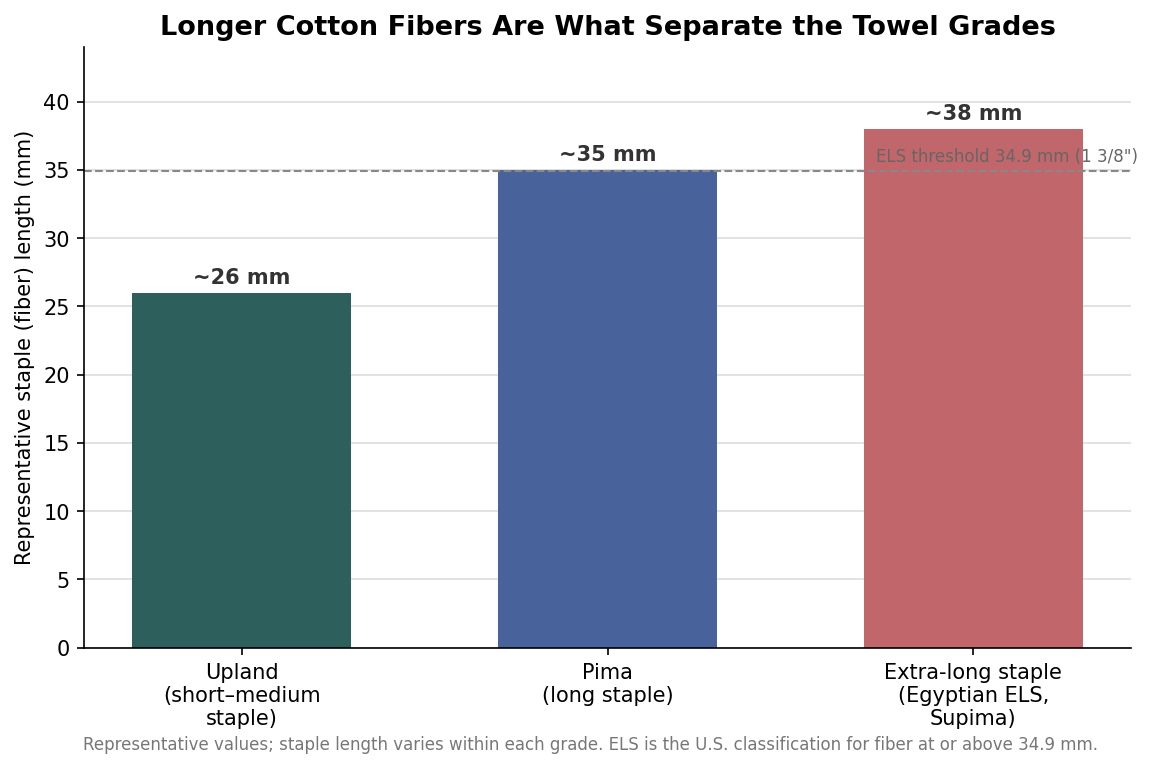
That single dimension explains most of the price gap between an economy gym towel and a spa towel. It also explains why two towels can share the same weight and still feel completely different: heavier cotton spun from short fibers can still shed and roughen, while a lighter towel from extra-long-staple fiber can stay smooth for years.
Turkish versus Egyptian is a choice of direction, not a ranking
Both Turkish and Egyptian cotton are prized long-staple fibers, and the honest answer to “which is better” is that they are tuned for different jobs. Turkish cotton is highly absorbent and quick-drying, and it tends to get softer with every wash. That fast dry time makes it a strong pick for towels that turn over quickly — poolside, gym, salon, anywhere a towel needs to be ready again soon. Egyptian cotton is also absorbent but, woven densely at higher thread counts, it holds more water and dries more slowly, trading turnaround for a plush, silky, hotel-suite feel. Its longer, stronger fibers also make it a touch more durable and less prone to pilling. Neither is the universal winner. A busy fitness brand and a boutique hotel should reasonably reach different conclusions, and the deciding factor is usually how fast the towel needs to dry between uses.
Pima and Supima: the extra-long-staple middle ground
Pima is the general name for extra-long-staple cotton grown in the United States, Peru, and Australia, and Supima is a trademarked certification reserved for cotton grown from American Pima varieties. Buying Supima specifically buys traceability: the mark verifies that the fiber is genuine American extra-long-staple rather than a blend quietly cut with shorter cotton, which is a recurring problem with loosely policed “Egyptian” labeling. For a custom program where consistency across reorders matters, a certified fiber removes a variable. Performance-wise, Pima and Supima land where their staple length predicts — smooth, strong, low-lint, and softer over time — without necessarily carrying the price premium of top-tier Egyptian.
How the yarn is spun decides how the towel ages
Staple length sets the ceiling; spinning method decides how much of that potential survives real-world laundering. Ring-spun cotton twists the fibers into a compact, cohesive yarn. It feels soft and smooth, resists snagging and pilling, and holds its structure through repeated heavy washing, which is why it is the default for hotels and other high-traffic properties. Zero-twist (also called low-twist) cotton uses little or no twist, producing a yarn that is exceptionally lofty and plush straight out of the package and highly absorbent at first. The catch is durability: those untwisted loops can break down faster under frequent, hot commercial laundering, leading to earlier snagging and pilling. Zero-twist rewards a gentle home laundry routine and struggles in an industrial one. If your towels will be washed on a punishing commercial cycle, ring-spun is the safer specification even though zero-twist wins the first-impression test.
Read GSM as weight, not as quality
Grams per square meter, or GSM, measures how much the fabric weighs and therefore how dense and thirsty the pile is — but it says nothing about the cotton grade. Lightweight gym and economy towels commonly fall around 300 to 400 GSM, standard bath towels around 400 to 550, hotel and premium towels around 550 to 700, and luxury or spa towels around 700 to 900. The chart below maps those bands.
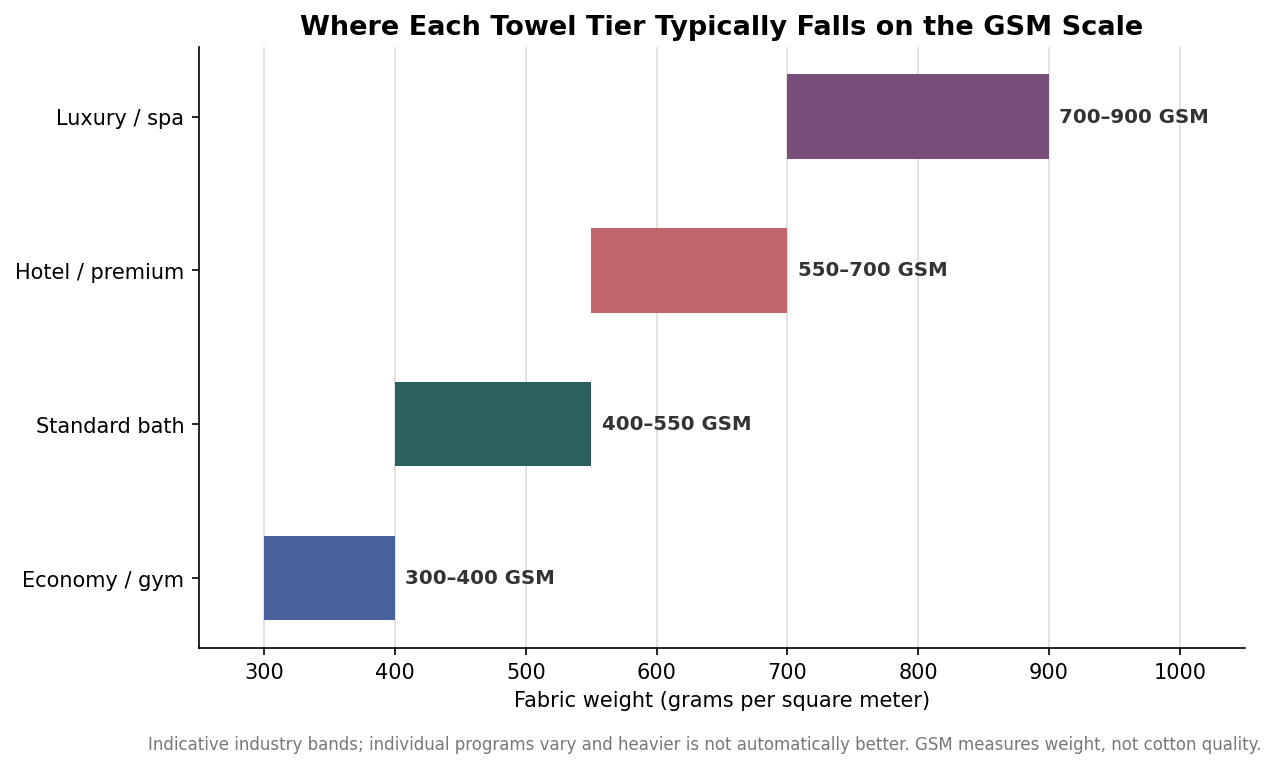
Heavier is not automatically better. A 900 GSM towel is dense and luxurious but slow to dry and demanding on laundry equipment, while a well-made 500 GSM towel from long-staple, ring-spun cotton can outperform a cheap heavyweight on feel and longevity. Read GSM alongside the fiber and yarn story, never on its own.
Match the cotton to the order
Put the pieces together around the actual use. A spa or luxury retail line leans toward extra-long-staple cotton, ring-spun, in the 600 to 900 GSM range, where the smooth hand justifies the price and the branding. A hotel or gym program that lives on commercial laundry should prioritize ring-spun long-staple cotton at a sensible 500 to 650 GSM, buying durability and dry time over maximum plushness. A promotional or event towel can sit at economy weight and grade, since it will not face years of washing. Whatever the tier, decoration method interacts with the fiber: dense, long-staple pile takes embroidery cleanly, while heavily textured or very high-loft towels can complicate fine stitch detail. The figures here are indicative and vary by mill and program, so treat them as a framework for the conversation with your supplier, then confirm the specifics against a sample before committing to a run.