The decoration method matters as much as the towel underneath it. Two spa towels can share the same 550 GSM combed-cotton base and still feel like different products depending on whether the logo is embroidered, woven into the pile, screen printed, or sublimated. Each method changes what your artwork can look like, how the branding survives laundering, how small an order you can place, and what you pay per piece. Here is how the four common methods compare, and how to match one to your towel and your run size.
Embroidery: dimensional, durable, best for logos and monograms
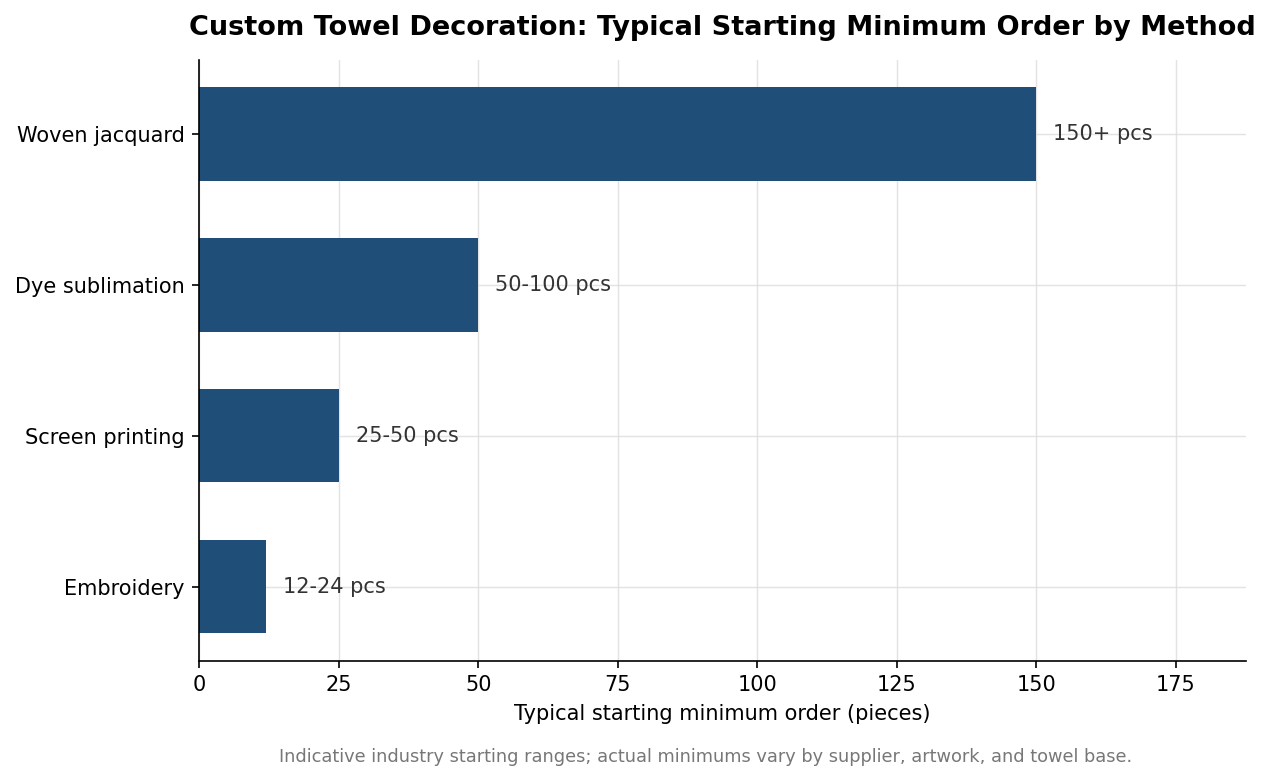
Embroidery stitches thread directly into the terry, producing a raised, textured mark that reads as premium. Pricing is driven by stitch count rather than the number of thread colors, so a two-color monogram and a four-color crest cost about the same when they use a similar number of stitches. A compact chest-style logo typically runs a few thousand up to roughly 8,000 to 12,000 stitches; larger designs climb from there and cost proportionally more. Because the mark is thread rather than ink, it resists repeated washing without cracking or fading, which is why hotels, golf clubs, and spas favor it for corner logos. The trade-offs are real: embroidery cannot reproduce photographs, fine gradients, or very small text cleanly, and dense stitching on a plush, high-loop towel can pucker if the design is too heavy for the pile. Keep embroidered art simple, bold, and reasonably sized. Minimums are often the most forgiving of any method, sometimes as low as a dozen pieces, because setup is limited to digitizing the design once.
Woven and jacquard: the logo becomes the towel
With dobby or jacquard weaving, the pattern is built on the loom as the towel is made, so the design is part of the fabric structure rather than something applied on top. A woven border or an all-over jacquard motif will never peel, crack, or wash off because nothing sits on the surface. This is the most permanent option and the one that looks most integrated, which is why it appears on high-end hospitality and retail towels. The constraints come from the loom: color counts are limited, fine detail and photographic imagery are off the table, and the economics only work at volume. Setting up a weave carries real tooling and sampling cost, so minimums commonly start in the low hundreds and lead times run longer than surface decoration, often several weeks once a woven sample, called a strike-off, is approved. Treat woven branding as a commitment you make when the design is settled and the quantities justify it.
Screen and pad printing: flat color, low unit cost at volume
Screen printing pushes cured ink through a stencil, one screen per color. It handles bold, solid-color logos well, and once the screens are made it prints quickly enough that the per-towel cost drops sharply as the run grows. Expect minimums in the range of roughly 25 to 50 pieces, and expect the price to step up with each additional ink color, because each color is a separate screen and setup. It is not the method for gradients, photographs, or tiny text; those need sublimation. On dark towels the shop lays down a white underbase first so colors stay true, which adds a pass. Cured ink bonds firmly and holds up to laundering, though on a deep, plush pile a printed mark can look slightly less crisp than on a flat woven surface because the loops break up the ink. Pad printing is a close cousin used for very small marks on flatter areas, and it shares the same flat-color, low-color-count profile.
Dye sublimation: full color, but polyester only
Sublimation turns solid dye into gas under heat and pressure so it bonds inside the fiber, producing photographic, unlimited-color results that will not crack because there is no surface layer at all. It is the only method here that reproduces gradients and complex imagery edge to edge. The catch is chemistry: sublimation dyes only bond to polyester, so the process works on 100% polyester or high-polyester microfiber towels and does not work on cotton. This is the single most common mistake buyers make, ordering a plush cotton terry towel and expecting a full-color sublimated print. If you need photographic color, you are choosing a polyester or poly-topped microfiber towel, which feels different from cotton terry: quicker-drying and smoother, well suited to gym, rally, beach, and promotional towels, and less suited to a luxury bath set. Per-unit cost stays consistent regardless of how many colors are in the art, which makes sublimation competitive for complex, multicolor designs even though a simple one-color job is usually cheaper by screen print.
Matching the method to the towel and the order
Start from two fixed points: the fabric you want the guest to feel, and the artwork you already have. A cotton bath or spa towel rules sublimation out immediately, which leaves embroidery for a logo or monogram, weaving for an integrated border, or screen printing for a flat graphic. A full-color photographic design forces the reverse decision, since you accept a polyester or microfiber base so sublimation can do its job. Order size is the next filter. Small runs and sampling favor embroidery and screen printing because their setup is cheap, while woven branding rarely pays off below the low hundreds.
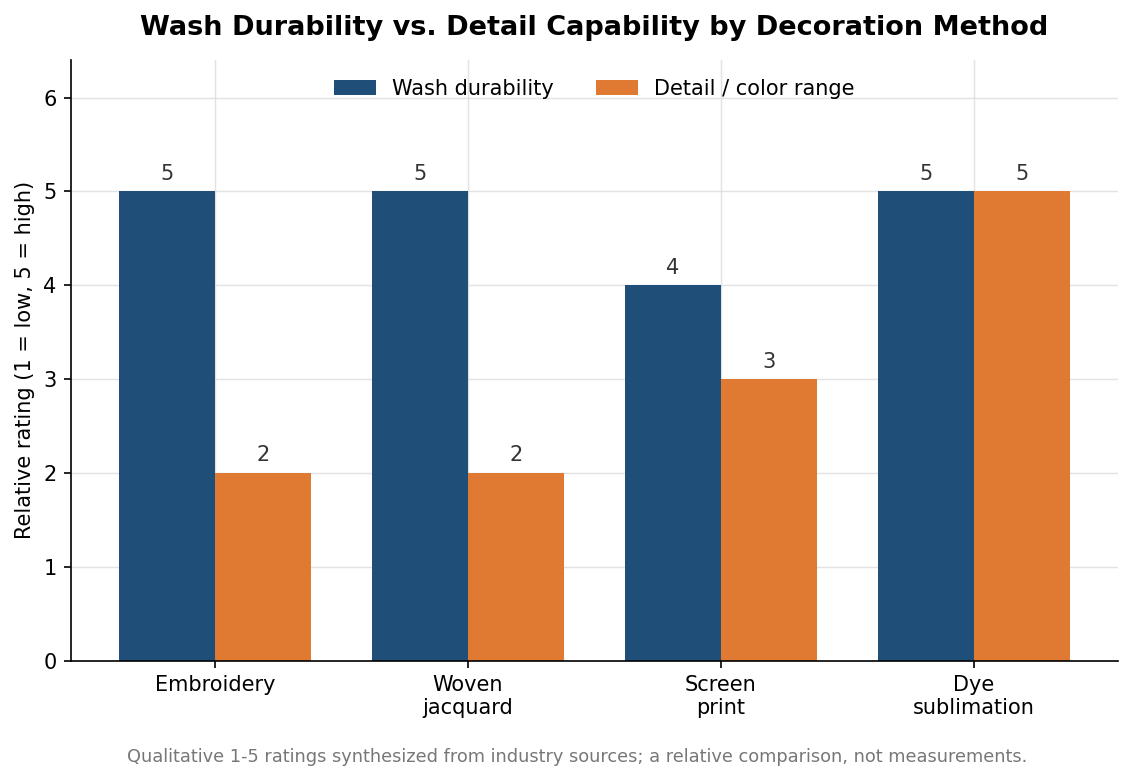
Then look at where the towel lives. Anything facing heavy commercial laundering, meaning daily washes, high heat, and industrial detergent, rewards the most durable marks, which is why woven and embroidered branding dominate hotel and gym inventory, and why a printed towel destined for that environment should be tested through several wash cycles before you commit to a large run. Finally, prepare art in the right format: embroidery and printing both want clean vector files, while sublimation wants high-resolution raster art at 300 DPI or better. Send a real proof or a physical sample before a large order regardless of method, because the difference between an approved strike-off and a hopeful email is the difference between a reorder and a write-off.
No single method wins on every axis. Embroidery and weaving buy you permanence and a premium feel at the cost of color and detail; printing buys you low unit cost on simple graphics; sublimation buys you full-color imagery at the cost of being locked to polyester. Decide the fabric and the artwork first, and the right decoration method usually narrows to one.