A custom towel that looks plush on the sample table can still be a bad buy. If it is going into a hotel, spa, gym, or any setting with an industrial laundry behind it, the question is not how it feels on day one but how it looks and absorbs after a few hundred wash cycles at high temperature with commercial detergent and bleach. Specifying for that reality means paying attention to weight, cotton construction, finishing, and the standards you put in writing. Here is what each of those actually controls.
GSM sets the ceiling for absorbency and the floor for laundry cost
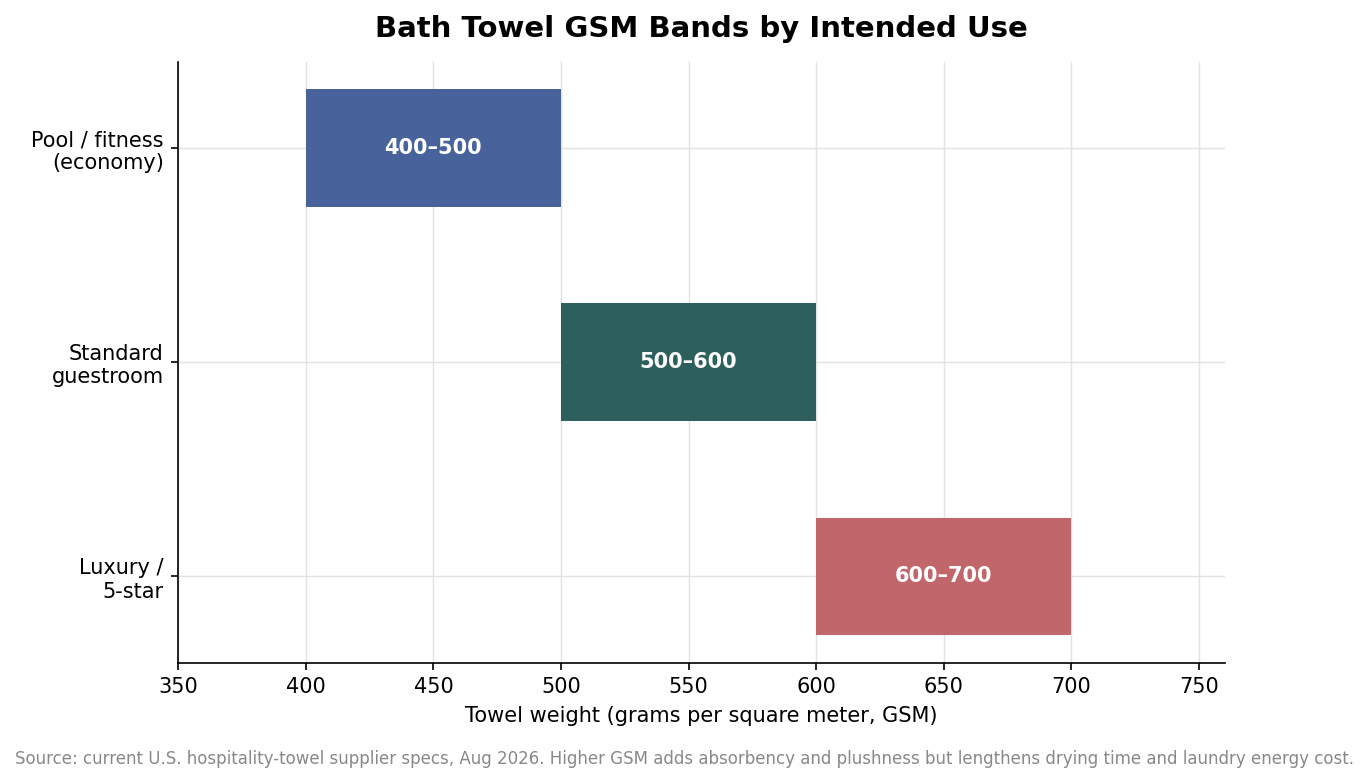
Towel weight is measured in grams per square meter, and it is the single spec that most shapes both guest experience and operating cost. Lighter towels in the 400 to 500 GSM range are the standard choice for pools and fitness centers: they dry fast, launder cheaply, and take less energy to tumble dry. Mid-weight towels around 500 to 600 GSM are the workhorses of typical hotel guestrooms, balancing a soft hand against reasonable drying time. At the top, 600 to 700 GSM is luxury and five-star territory, where the plush, highly absorbent feel is part of the product.
The trade-off is real and it is ongoing. Every extra 100 GSM adds absorbency and perceived quality, but it also holds more water, takes longer to dry, and costs more energy and time per laundry cycle across the towel’s whole life. Because laundering is a recurring cost and the purchase is one-time, the GSM decision is really an operating-cost decision disguised as a comfort decision. Pick the lowest weight that still meets the guest expectation for the space rather than defaulting to the heaviest towel you can afford.
Cotton construction is what survives 300 washes
Weight tells you how a towel feels; construction tells you how long it lasts. The durable standard for commercial towels is 100 percent ring-spun, long-staple cotton, often named as Egyptian, Pima, or Supima. Long-staple fibers are simply longer, so they can be spun into a stronger, smoother yarn with fewer loose ends to work free and pill. Ring spinning tightens that yarn further. For the loop pile that does the actual absorbing, a two-ply yarn holds up better than single-ply under the mechanical stress of industrial washing and drying.
Get that construction right and a commercial towel is generally built to withstand 300 or more industrial wash cycles, which at standard occupancy tends to translate to a replacement timeline of roughly 12 to 18 months. Those figures are indicative and depend heavily on wash chemistry and temperature, but they give you a benchmark: if a supplier’s towel is degrading, thinning, or shedding well before a few hundred washes, the cotton or the yarn ply is the likely culprit, not the laundry. This is also why the cheapest towel is rarely the cheapest towel over its life; a unit that lasts half as long doubles both the replacement and the labor cost of swapping it out.
The finishing details that fail first
Towels almost never fail in the middle. They fail at the edges, where hems fray, corners tear, and borders unravel after repeated high-speed extraction. That makes finishing a durability spec, not a cosmetic one. Look for double-stitched hems with reinforced corners, and a woven dobby or cam border rather than a thin folded edge, because the woven band resists the pulling and snagging that shortens a towel’s usable life.
Color is the other thing industrial laundries punish. Commercial wash cycles combine high temperature, alkaline detergent, and often chlorine bleach, all of which strip dye. The specification to ask for is colorfastness graded to AATCC 61-2A at Grade 4 or better after 50 washes, which is a recognized way of saying the towel should hold its color through repeated commercial laundering rather than graying or fading within weeks. If you are printing or embroidering a logo, confirm the branding method is rated for the same wash regime; a screen print that cracks or an embroidery thread that bleeds undoes the point of a branded towel.
Get the sizes and par levels right
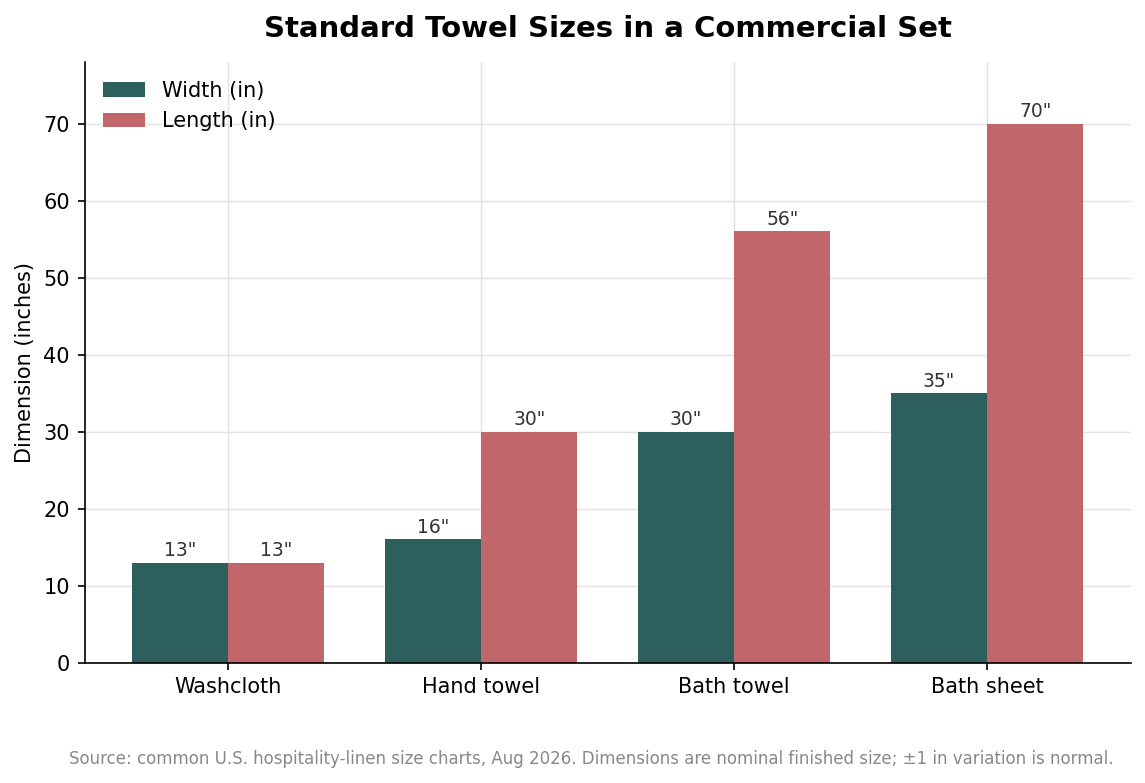
Finally, order the right pieces in the right quantities. A commercial towel set is not one item but a family, and the nominal sizes are fairly standardized: a bath towel at about 30 by 56 inches, a larger bath sheet at roughly 35 by 70 inches, a hand towel near 16 by 30 inches, and a washcloth around 13 by 13 inches. Expect about an inch of variation in either direction as normal for woven terry. Deciding which pieces a room or facility needs, and at what weight each, is part of the spec; a gym may want only bath towels and washcloths, while a hotel bathroom carries the full set.
Quantity is governed by rotation, not headcount. Because a towel is either in use, in the laundry, or on the shelf at any moment, the common planning rule is a par level of about three times peak occupancy so that a full clean set is always available while the last set is being washed. Under-buying here quietly raises cost, because running a thin par forces more frequent, smaller laundry loads and wears each towel faster.
Put those four things in the purchase order in plain terms: the GSM for each towel type, the cotton construction and yarn ply, the finishing and colorfastness standards, and the sizes and par quantities. A supplier can meet a spec written that way, and you will be comparing quotes on the same terms instead of guessing why one towel costs twice another. The towel that survives commercial laundering is almost always the one that was specified for it up front.