Ask a towel supplier one question and it tells you almost everything: what is the GSM? Grams per square meter is the single number that most shapes how a towel feels in the hand, how much water it drinks, how long it takes to dry, how long it lasts in a laundry cycle, and what it costs. It is also the number buyers most often get wrong, either paying for a plush weight a gym will hate or ordering an economy towel for a spa that needs to feel like a hug. This is a spec comparison built around GSM, so you can pick a weight on purpose rather than by accident.
What GSM actually measures
GSM is density, not thickness. It expresses how many grams of cotton are packed into a square meter of towel, which correlates closely with how substantial the towel feels and how much water the terry loops can hold. A higher number means more yarn per unit of area: taller or denser loop pile, a heavier hand, and more raw material. Because it is a weight-per-area figure, GSM lets you compare two towels of different sizes fairly, which a simple “it feels thick” impression cannot. It is not a quality score on its own, but it is the honest starting point for a specification, and it maps neatly onto use cases once you know the tiers.
The GSM tiers, from gym towel to hotel spa
Towels sort into a few practical bands. The lightweight tier, roughly 400 to 500 GSM, is thin, quick-drying and economical, which is exactly what a pool deck, a fitness center or a giveaway race towel wants; absorbency is modest but the towel dries fast and costs the least. The mid tier around 500 to 600 GSM is the hospitality workhorse and the sweet spot for most everyday bath towels, balancing real absorbency against reasonable drying time and laundry cost, which is why it is the standard weight in a great many guestrooms. The premium tier at 600 to 700 GSM and beyond is where towels turn plush and hotel-luxury: high absorbency, a soft heavy drape, and a longer usable life, at the price of slower drying, more expensive laundering, and a higher unit cost. Bath mats are their own case and often run heavier still, in the 700 to 900 GSM range, because the job there is to soak up water off a floor rather than to feel light on a rack.
The trade-off nobody mentions: absorbency versus dry time
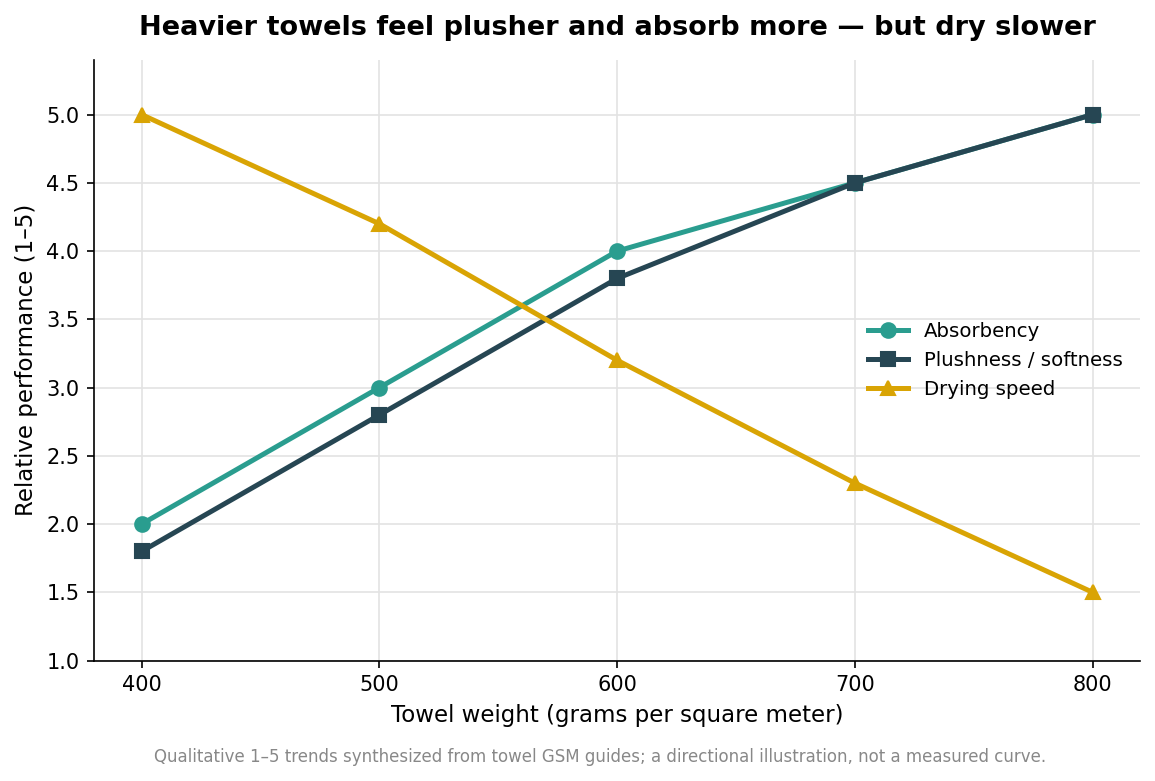
The instinct to just buy the heaviest towel is a trap. The same density that makes a 700 GSM towel feel luxurious and drink up water also makes it slow to dry, both on the rail after a shower and in a commercial dryer between guests. For a home spare bathroom or a boutique hotel positioning itself on comfort, that plushness is the whole point and the slower dry time is acceptable. For a busy gym, a swim club, a salon that runs towels through the wash all day, or an Airbnb turned over every morning, a lighter 450 to 550 GSM towel that dries quickly and survives frequent hot washes is the smarter buy, even though it feels less indulgent. Weight also drives operating cost in ways buyers forget: heavier towels take more energy and time to launder and dry, so a high-GSM order carries a higher lifetime cost beyond the purchase price. Decide how the towel will be laundered before you fix the weight.
GSM is not the whole story: cotton and construction
Two towels at the same GSM can feel very different, because the fiber and the weave matter alongside the weight. Long-staple cottons such as Egyptian, Supima and Turkish varieties spin into stronger, smoother yarn that feels softer and tends to last longer than generic short-staple cotton at the same weight, and Turkish cotton in particular is prized for getting softer with washing while drying relatively quickly. Zero-twist construction, where the loops are left largely untwisted, produces a towel that feels exceptionally soft and absorbent for its weight, though the trade can be a bit less durability over many industrial washes. Ring-spun and combed cottons clean up stray fibers for a smoother, stronger surface. The practical lesson is to treat GSM as the anchor of your spec and then ask about staple length and yarn construction, rather than assuming a heavy towel is automatically a good one.
Matching GSM to the order, with sizes
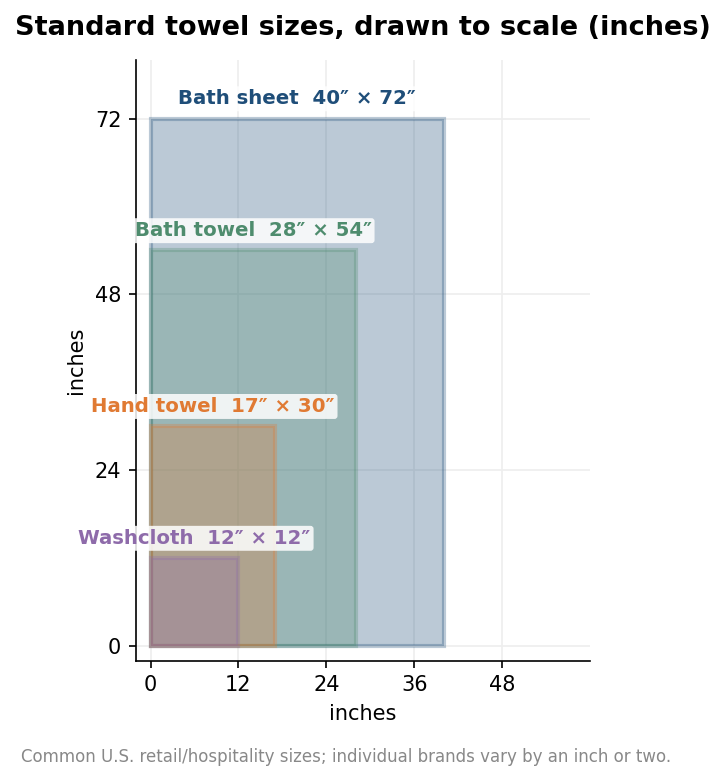
Put weight together with size and the order writes itself. Standard dimensions are fairly consistent across the industry: a washcloth is about 12 by 12 inches, a hand towel roughly 17 by 30, a bath towel around 28 by 54, and a generous bath sheet about 40 by 72, with an inch or two of variation between brands. A logo-embroidered mid-weight bath towel around 550 GSM suits a hotel or a branded gift that has to look good and hold up; a light 450 GSM towel fits high-turnover pool and fitness use; a plush 650 to 700 GSM bath sheet reads as luxury for a spa or a premium retail line. One branding note worth flagging: dense terry embroiders cleanly, which is why hotel and spa towels usually carry stitched logos, while a printed graphic often needs a sheared or velour panel because standard cotton loop pile does not hold a print the way a flat fabric does. Treat specific prices and lead times as indicative until a supplier quotes your exact weight, size and quantity, and let the towel’s real job, comfort or turnover, choose the GSM first.